
Sleeping Positions That Help (and Hurt) Your Back
The way you sleep can make or break your back. Learn which sleeping positions promote spinal healing and which ones are silently causing damage, plus tips on pillows, mattresses, and morning stretches.
We spend roughly eight hours a day sleeping: that is a third of our entire lives. Most people pay careful attention to their posture while sitting at a desk or lifting heavy objects, yet they give almost no thought to the position their body holds for those eight continuous hours each night. The truth is that the wrong sleeping position can cause new back pain or worsen an existing condition, while the right one supports the spine's natural curves and promotes genuine healing. Understanding how sleep posture affects your back is one of the simplest and most impactful changes you can make for long-term spinal health.
Why Sleep Position Matters
Your spine has three natural curves (cervical, thoracic, and lumbar) that work together to distribute mechanical load and absorb shock. During the day, your muscles actively support these curves. When you fall asleep, however, that active muscular support largely switches off. The position you sleep in determines whether your spine maintains its neutral alignment or is forced into sustained, unnatural postures for hours on end.
A poor sleeping position creates prolonged stress on intervertebral discs, facet joints, ligaments, and muscles. Over weeks and months, this nightly strain accumulates. It can lead to morning stiffness, chronic low back pain, neck pain, and even radiating nerve symptoms. The good news is that adjusting your sleep posture, and supporting it with the right pillow and mattress, can interrupt this cycle and give your spine the recovery time it needs.
The Best Positions for Your Back
On Your Back (Supine)
Sleeping on your back is widely regarded as the best overall position for spinal health. It distributes your body weight evenly across the largest surface area, minimizes pressure points, and allows the head, neck, and spine to rest in a neutral position. There is no rotational force on the neck, and the lumbar curve is gently supported by the mattress beneath it.
To optimize this position, place a small pillow or rolled towel under your knees. This slight bend in the legs reduces tension on the lumbar spine and prevents the lower back from arching excessively. Use a pillow under your head that is thick enough to support the cervical curve without pushing the head forward.
On Your Side
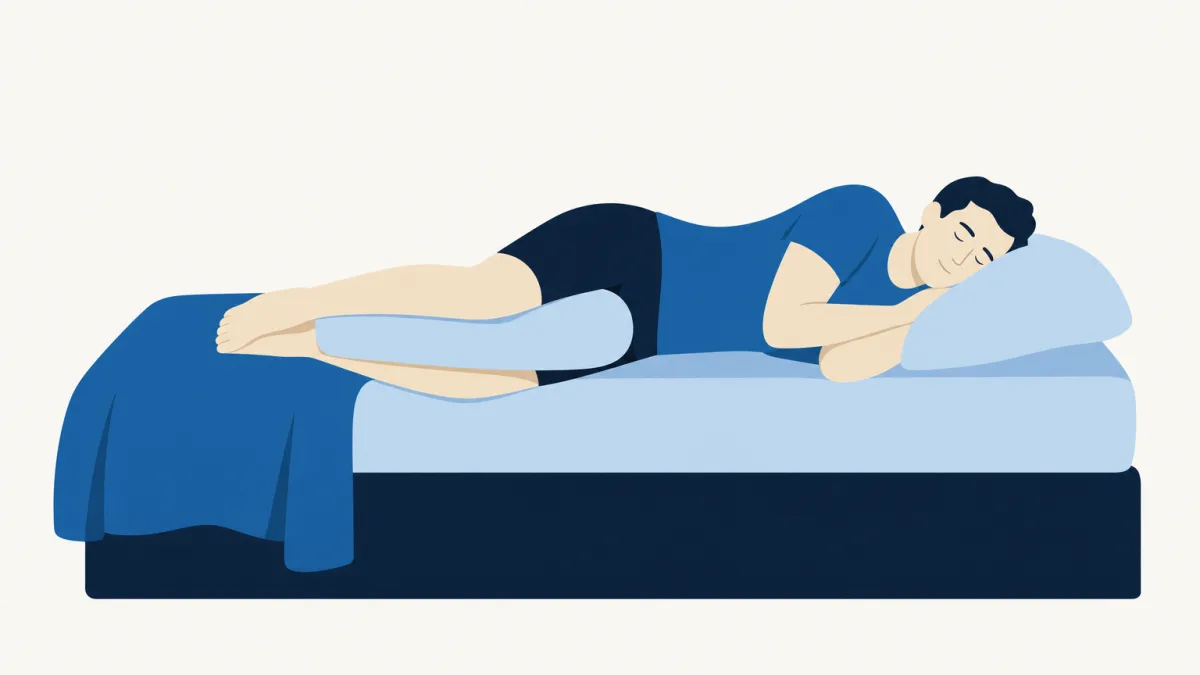
Side sleeping is the second-best option and is especially beneficial for people who snore or suffer from sleep apnea. The key is to keep the spine as straight as possible. Place a firm pillow between your knees to prevent the upper leg from pulling the pelvis downward and rotating the lumbar spine. Your head pillow should be thick enough to fill the gap between your shoulder and ear, keeping the cervical spine level.
One common mistake is curling into a tight fetal position. While a gentle bend at the hips and knees is fine, excessive curling rounds the spine, compresses the chest, and can strain the lower back and hip joints over time. Aim for a relaxed, elongated side-lying posture.
The Recovery Position (Side with Arm Support)
For patients recovering from a disc herniation, a modified side-lying position can offer significant relief. Lie on the unaffected side with a pillow between your knees and gently hug a second pillow in front of your chest. This prevents the upper body from rolling forward, keeps the spine neutral, and reduces pressure on the damaged disc. Many patients find this position allows them to sleep through the night with considerably less pain.
The Worst Position: Stomach Sleeping
Sleeping on your stomach is the most problematic position for spinal health. Because you cannot breathe face-down into a pillow, the neck is forced into a sustained rotation to one side, often for hours at a time. This places enormous asymmetric stress on the cervical vertebrae, discs, and surrounding muscles. Meanwhile, the weight of the torso sinks into the mattress, flattening the natural lumbar curve and compressing the facet joints in the lower back.
If you are a committed stomach sleeper and find it difficult to change, there are ways to reduce the damage. Use a very thin pillow, or no pillow at all, to minimize the angle of neck rotation. Place a flat pillow under your pelvis and lower abdomen to help restore some of the lumbar curve. Over time, try transitioning to side sleeping by placing a body pillow along your front to simulate the feeling of lying face-down.
Choosing the Right Pillow and Mattress
Even the best sleeping position will fail you if your pillow and mattress are working against you. A medium-firm mattress generally provides the ideal balance of support and comfort for most back pain sufferers. It is firm enough to maintain spinal alignment but soft enough to accommodate the natural curves of the shoulders and hips. Extremely soft mattresses allow the body to sag, while very firm surfaces create pressure points that force the spine out of alignment.
Your pillow deserves just as much attention. The primary job of a pillow is to keep the cervical spine in a neutral position, meaning the neck is neither flexed upward nor dropped downward. Back sleepers generally need a thinner, contoured pillow, while side sleepers need a thicker one that fills the gap between the shoulder and the head. Stomach sleepers, as mentioned, should use the thinnest pillow available.
Replace your pillows every one to two years, as they lose their shape and supportive properties over time. Mattresses should be replaced roughly every eight to ten years, though this varies by material and quality. If you notice a visible sag or wake up stiff despite sleeping in a good position, your mattress may be due for an upgrade.
Morning Stretches to Undo Sleep Strain
No matter how well you position yourself at night, the body can still feel stiff after hours of relative immobility. A brief morning stretching routine, just two to three minutes, can release tension, restore blood flow, and prepare your spine for the day ahead. Perform each of the following stretches gently, holding for about thirty seconds:
- Knee-to-chest stretch: Lying on your back, pull one knee toward your chest and hold it with both hands. This releases tension in the lower back and glutes. Repeat on the other side.
- Gentle spinal twist: Still on your back, let both bent knees fall to one side while keeping your shoulders flat on the bed. This mobilizes the thoracic and lumbar spine. Repeat on the opposite side.
- Cat-cow stretch: On your hands and knees, alternate between arching your back upward (cat) and letting your belly drop toward the floor (cow). This warms up the entire spinal column and restores segmental mobility.
- Pelvic tilts: Lying on your back with knees bent and feet flat, gently flatten your lower back into the mattress by tilting your pelvis upward, then release. This activates the deep core stabilizers and relieves morning stiffness in the lumbar region.
When to Seek Professional Help
If you are waking up with back pain on a regular basis despite adjusting your sleeping position, pillow, and mattress, the problem may run deeper than sleep posture alone. Underlying spinal misalignments, disc issues, or muscular imbalances often require professional assessment and targeted treatment. A chiropractic evaluation can identify the root cause of your morning pain and provide a clear, personalized plan for recovery. Do not let another restless night define your mornings. Schedule an assessment and start sleeping the way your spine was designed to.